On this page
Published July 13, 2026 — Waseem Nasir, SkynetLabs
Ask any solo contractor what happens to their phone during job hours: hands full, ladder up, phone buried in a work bag — calls ring out to voicemail. Most callers don't leave a message. They call the next name on the list. That's not a marketing problem. That's a plumbing problem in the business itself: leads are arriving and nobody is home to catch them.
I build the system that fixes that. I call it an AI Ops Command Center — not because it's one product, but because it's the right name for what it actually is: a small stack of connected pieces that make sure no lead, call, or email sits untouched longer than about a minute, at any hour, without anyone standing by a phone.
The Missed-Call Problem Nobody Budgets For
Here's the pattern I keep seeing across home services, clinics, and logistics operators: the business spends real money getting the phone to ring — ads, SEO, referral programs, a Google Business Profile people trust enough to call. Then the call rings out because the owner is elbow-deep in a job, the front desk is on lunch, or it's 8pm and the office closed at 5. The lead doesn't wait around. They call the next result.
Speed to lead is the term for how fast you respond to a new inquiry, and it's brutally unforgiving — the businesses that reply first tend to win the job, not the businesses that reply best. A perfect quote sent six hours later loses to a mediocre "we can be there Tuesday" sent in ninety seconds. Most small businesses know this instinctively. What they don't have is a way to guarantee the fast reply happens every single time, including nights, weekends, and the fifteen minutes when the only person who answers phones is in the bathroom.
That's the gap an AI Ops Command Center closes. Not by hiring another front-desk person — by putting an always-on layer between "the phone rings" and "someone finally calls back."
What Is an AI Ops Command Center?
It's five pieces working off the same lead data, so nothing falls through a gap between systems:
1. Speed-to-Lead, Automated
The moment a lead comes in — call, web form, ad click, Google Business message — the system reacts immediately instead of waiting for a human to notice. That's the whole discipline: treat the first sixty seconds after a lead arrives as the highest-value minute in the sales process, because it is.
2. Missed-Call Text-Back
If a call isn't answered, the caller gets a text within seconds — before they've even had time to dial the next business on their list. Something as simple as "Sorry we missed you — what do you need help with? We'll get right back to you" keeps the conversation alive instead of letting it die in voicemail purgatory. This alone recovers leads that would otherwise vanish with zero record they ever called.
3. An AI Receptionist That Answers, Qualifies, and Books
This is the piece people picture first: an AI voice or chat agent that picks up the call or the text thread, answers the questions it's been trained to answer, asks the qualifying questions you'd ask yourself, and — when the lead is a fit — books straight into your calendar. No tag, no "someone will call you back." The appointment exists before the conversation ends.
4. AI Email Triage
Inboxes rot the same way phone lines do — a wall of unread messages where the urgent request from a paying client sits under forty newsletters. AI email triage reads incoming mail, classifies it (urgent, routine, spam, needs-a-human), drafts a reply where one's appropriate, and routes anything that actually needs a decision to the right person instead of the bottom of an inbox.
5. A Live Ops Dashboard
All of the above is worthless if nobody can see it's working. The dashboard is the single screen that shows what came in, how fast it got answered, what got booked, and what's still open. It's the difference between "I think the AI is handling things" and actually watching it happen.
How It Works — The Stack, and Why It's Built in Your Accounts
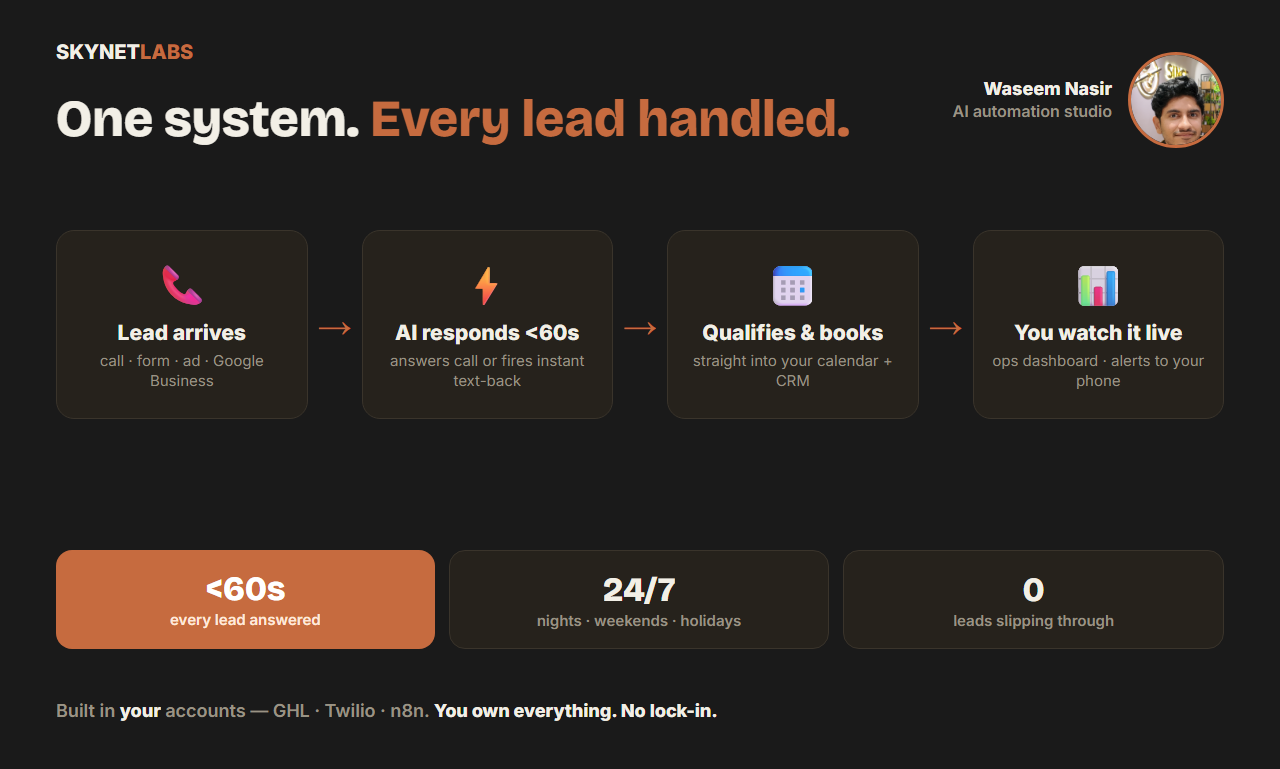
The system is built on three tools working together: GoHighLevel as the CRM, calendar, and pipeline layer; n8n as the automation and orchestration engine that wires everything together and handles the logic (routing, retries, error alerts); and Twilio as the voice and SMS carrier underneath the AI receptionist and text-back flow.
The deliberate choice I make on every build: everything runs inside your GoHighLevel account, your n8n instance, and your Twilio number — not mine. That means you own the logins, the workflows, the phone number, and every byte of lead data the system touches. If you want to bring in a different developer next year, they can open the account and see exactly how it's wired, because none of it lives behind an agency-owned platform you'd have to migrate off. No lock-in isn't a marketing line here — it's a structural decision about whose account the automation lives in.
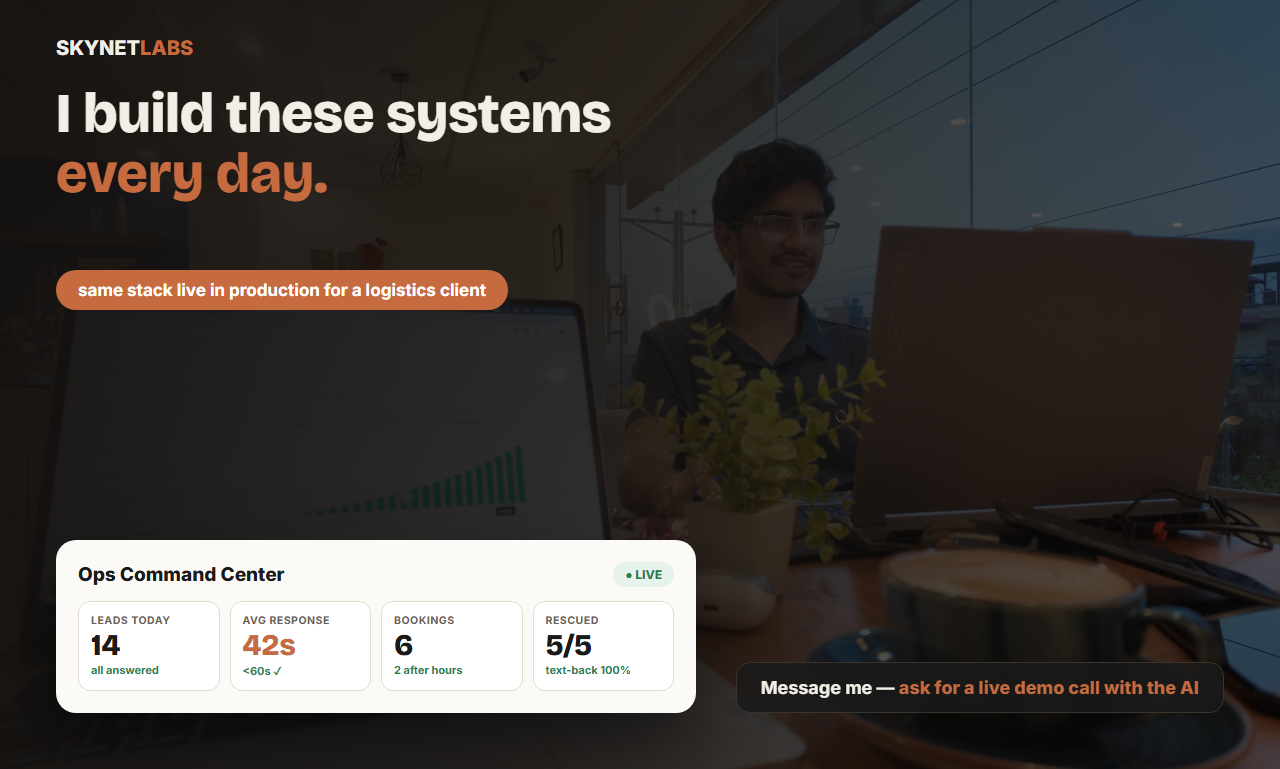
Practically, a build looks like this: I map your actual lead sources (calls, forms, ads, GBP messages) and your actual booking rules, then wire the AI receptionist and missed-call text-back into your existing phone number, connect email triage to your inbox, and build the dashboard against your live pipeline data — not a demo dataset. When I wired a version of this stack for a logistics client, the priority wasn't a flashy voice agent — it was AI email triage feeding a live ops dashboard their dispatch team checks every morning before anything else. That's the same underlying stack (GHL + n8n) doing the email-and-visibility half of what the full AI Ops Command Center does for lead capture.
What It Actually Costs to Run — the Honest Version
Two cost buckets, and I keep them separate on purpose because conflating them is how "AI automation" pitches turn into surprise invoices.
The build is a one-time project cost — designing the flows, configuring GoHighLevel, building the n8n workflows, wiring Twilio, and testing the whole thing against real scenarios before it goes live.
Running it is usage-based, billed to your own accounts, not mine. AI voice and SMS minutes typically run in the range of roughly $0.10 to $0.25 per minute, depending on which AI provider and model you use — that's the actual pass-through cost from the providers powering the conversation, not a markup I add. A business fielding a modest number of calls a day is looking at a real but modest monthly usage bill, not a per-seat SaaS subscription stacked on top of what you're already paying for GoHighLevel. I'd rather tell you the honest range up front than let you find out from a bill.
Who This Is For
This isn't for every business. It earns its keep specifically where a missed call or a slow reply has a direct, felt cost:
- Home services — HVAC, plumbing, electrical, cleaning — where the crew is on-site and can't answer, and the caller has three other numbers to try.
- Clinics and medspas — where front desk staff are already handling in-person patients and can't also field every inbound call in real time.
- Freight and logistics — where dispatch email volume alone buries the load requests that actually matter.
- Agencies and consultants — booking discovery calls off ad spend where a delayed reply is a wasted click.
If your business already has a full-time front desk who never misses a call and answers email inside minutes — you don't need this. If you're the person answering your own phone between jobs, or leads are quietly dying in a missed-call log nobody reviews, this is exactly the gap it closes.
Want to see where your own ops are leaking leads first? Run it through the Automation Gap Analyzer — 12 questions, about 90 seconds — before you commit to a build. It's free, part of the free tools I've put out for exactly this kind of decision.
FAQ
What is an AI Ops Command Center?
It's a small stack of connected systems, not a single app: an AI receptionist that answers calls and texts, a missed-call text-back automation, AI email triage that sorts and drafts replies, and a live dashboard that shows every lead's status. The goal is one thing — no inbound lead sits unanswered for more than a minute, day or night.
What is missed-call text-back and why does it matter?
Missed-call text-back is an automation that fires an instant text the moment a call to your business goes unanswered — before the caller has even hung up on voicemail and moved to your competitor. It matters because a missed call is usually a lost lead; a text sent within a minute keeps the conversation alive instead of starting cold on a callback hours later.
Does the AI receptionist actually book appointments?
Yes. Built on GoHighLevel's calendar and a voice/SMS AI layer, it can answer common questions, qualify the lead against rules you set, and book directly into your calendar in the same conversation — no human touch required unless the lead is flagged for follow-up.
How much does an AI Ops Command Center cost to run?
The build is a one-time project cost. After that, the ongoing cost is usage-based: AI voice/SMS minutes typically run roughly $0.10 to $0.25 per minute depending on the provider and model, billed to your own Twilio/AI accounts. A business handling a modest daily call volume is usually looking at a low monthly usage bill, not a per-seat SaaS fee.
Do I need to lock into SkynetLabs to keep the system running?
No. Everything is built inside your own GoHighLevel and n8n accounts, using your own Twilio and AI provider keys. You own the logins, the workflows, and the data. If you ever want a different developer to maintain it, they can — nothing is locked behind an agency-owned platform.
Is this proven, or just a concept?
The same stack runs in production today for a logistics company — AI email triage with a live ops dashboard their team checks every morning. The receptionist and missed-call text-back pieces use the same GoHighLevel + n8n + Twilio foundation.
Who is the AI Ops Command Center built for?
Service businesses where a missed call or a slow reply directly costs revenue — home services, clinics, logistics/freight, agencies, and any business fielding inbound calls or form leads without a full-time front desk covering every hour.
If you're losing leads to missed calls or a slow inbox, this is the system to fix it — built in your own accounts, no lock-in.
Book the build on Fiverr Schedule a free SkynetLabs discovery call
See the same n8n approach in more depth in the EU logistics email-triage case study, or compare the automation engine choices in n8n vs Zapier in 2026.