On this page
Google announced Gemini 4 Argon on 30 September 2026 and calls it its most powerful model yet. It is built for what Google describes as "complex, long-horizon workflows": real-world software engineering, enterprise knowledge work like legal and finance, and cybersecurity defence.
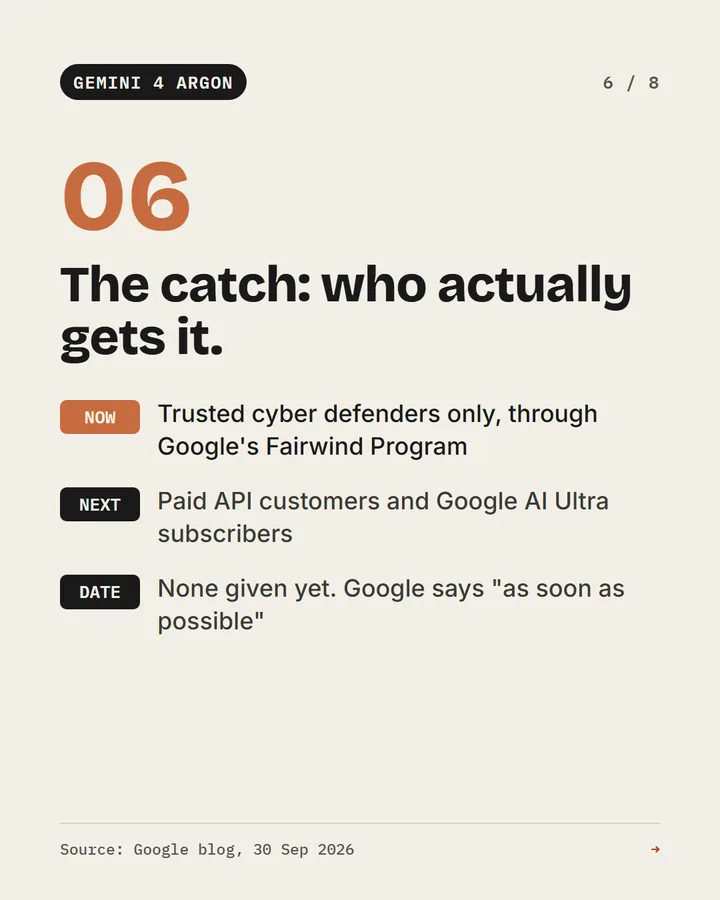
The catch is in the rollout. Today Argon is only with a set of trusted cyber defenders in Google's Fairwind Program. Paid API customers and Google AI Ultra subscribers are next, and Google has not given a date. So this post covers three things: what changes, what it will cost, and how to be ready the day it opens.
What actually changed with Gemini 4 Argon?
The headline is the output limit. One answer can now run to 1 million tokens, up from 64,000. A full migration plan, a long research pack or a complete module can come back in one pass instead of many stitched-together replies.
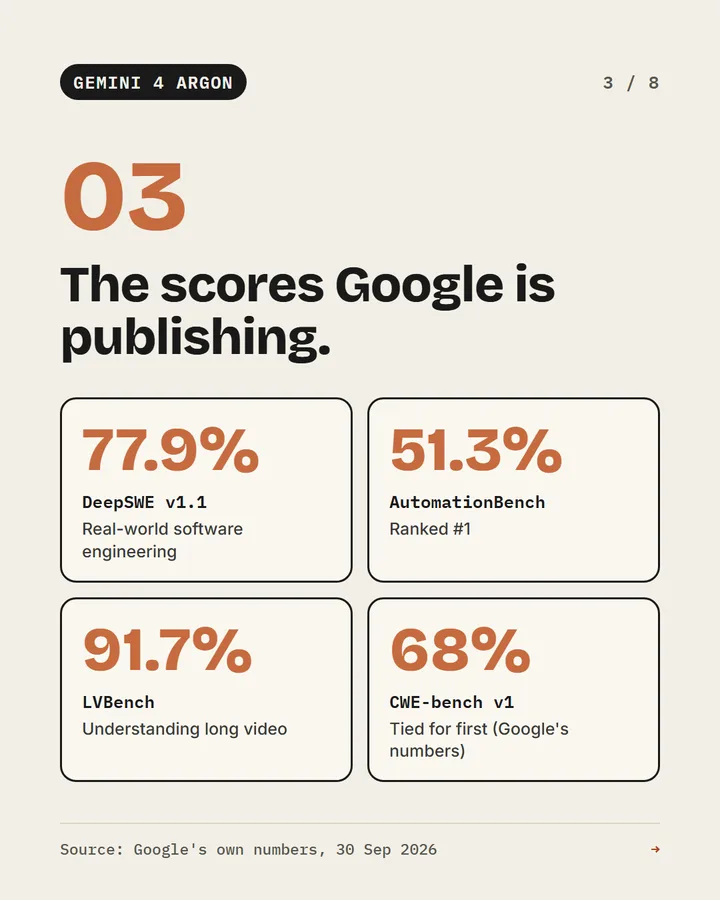
The scores Google is publishing (its own numbers, not independent tests yet):
| Benchmark | Argon | What it measures |
|---|---|---|
| DeepSWE v1.1 | 77.9% | Real-world software engineering |
| AutomationBench | 51.3% (ranked #1) | Automation tasks |
| LVBench | 91.7% | Understanding long video |
| CWE-bench v1 | 68% (tied first) | Security vulnerabilities |
| Gray Swan IPI | Leads | Resisting prompt injection |
Google also says Argon leads the Vals Index. The prompt-injection result is the one we would watch most closely. Prompt injection is hidden text in an email or web page that tries to take over an AI agent. It is the main reason businesses hesitate to let AI read their inbox, tickets or supplier sites.
From our 8-slide Argon carousel. Sources: Google blog, 30 Sep 2026.
How much will Gemini 4 Argon cost?
The introductory price is $2 per million input tokens and $10 per million output tokens, with cached input 95% off. After the introductory period it moves to $4 input and $20 output.
Read that as a price per job, not per token. A full 1M-token answer at the $10 intro rate is $10 for one run. That is cheap for a codebase migration and wasteful for every support email. The cache discount matters too: if you resend the same long system prompt or reference document on every call, most of that input gets the 95% discount after the first time.
Can you use Gemini 4 Argon today?
Most people can't. Argon is rolling out to trusted cyber defenders through Google's Fairwind Program, which is an application for vetted organisations: governments and national cyber authorities, critical-infrastructure operators and core technology platforms. If that is you, you can apply on the DeepMind Fairwind page.
There is no public API model ID and no general waitlist yet. We checked the Gemini API models page, the API changelog and OpenRouter on 1 October 2026. Google says the next group is paid API customers and Google AI Ultra subscribers, and that broader access will come "as soon as possible".
How do you get first in line?
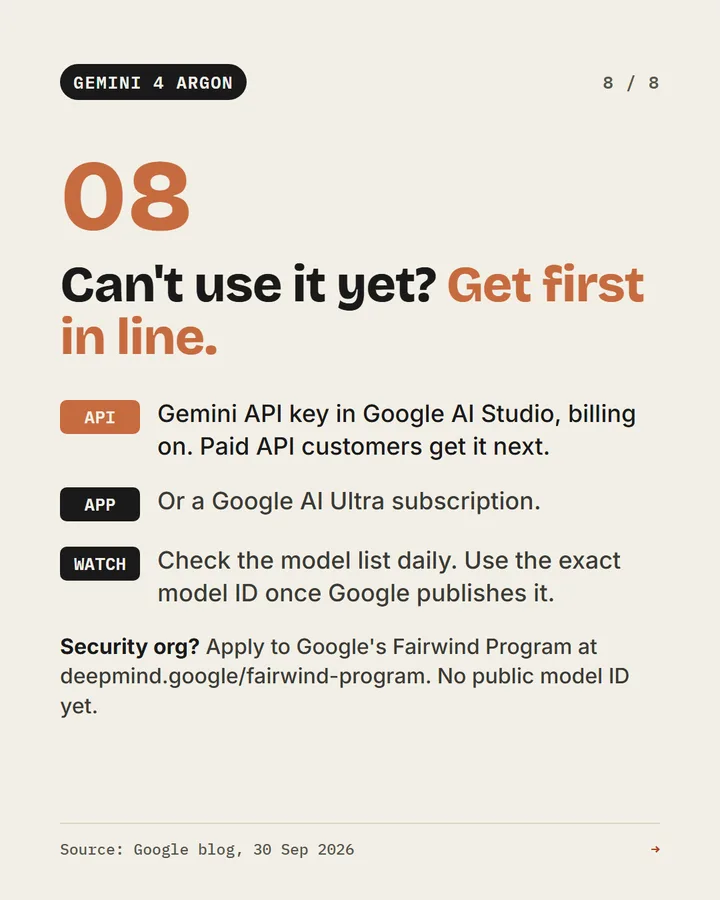
- Developers and automations: create a Gemini API key in Google AI Studio and turn on billing, so you are a paid API customer.
- Chat use: a Google AI Ultra subscription.
- Catch the day it goes live: list the models your key can see once a day, by hand or on an n8n schedule:
# first: pip install google-genai, then set GEMINI_API_KEY
from google import genai

client = genai.Client()
for m in client.models.list():
    if "argon" in m.name.lower():
        print("ARGON IS LIVE:", m.name)
When it appears, call it with the exact ID the list returns. Don't guess it. Put a cap on output tokens while you test, because 1M is a ceiling, not a target:
from google.genai import types

resp = client.models.generate_content(
    model="PASTE_ID_FROM_THE_LIST",
    contents="Plan the migration of this codebase from X to Y: ...",
    config=types.GenerateContentConfig(max_output_tokens=64000),
)
print(resp.text)
Where will Argon earn its price?
| Give Argon | Keep on a cheap model |
|---|---|
| Codebase migrations and big refactors | Email triage and replies |
| Long legal and finance research | Social captions and summaries |
| Security review of a site or repo | Classification and tagging in n8n |
| Long video analysis | Simple chat and FAQs |
In n8n, the switch is small: point your existing Gemini or HTTP Request node at the new model ID and keep the current model as a fallback branch. Keep a human approval step before anything is sent or deleted, even with better injection resistance.
Our take
The 1M-token output and the injection results are the two things that change how we build. One means fewer stitched jobs. The other, if it holds up, means agents can be trusted with more untrusted input. But these are Google's own scores, and nobody outside the Fairwind group can test it yet. We will re-run our own client tasks on it the week it opens, and keep the everyday work on smaller, cheaper models either way.
Frequently asked questions
When was Gemini 4 Argon released?
Google announced it on 30 September 2026. It is rolling out first to trusted cyber defenders through the Fairwind Program.
Can I use Gemini 4 Argon now?
Not unless your organisation is accepted into Google's Fairwind Program. Paid API customers and Google AI Ultra subscribers are next, with no date given.
How much does Gemini 4 Argon cost?
The introductory price is $2 per million input tokens and $10 per million output tokens, with cached input 95% off. The standard price afterwards is $4 input and $20 output per million tokens.
What is the Gemini 4 Argon model ID?
There is no public model ID yet. Once Google releases it, list the models your API key can see and use the exact ID returned.